Gender Justice

Title text required


In 2025, the global landscape for gender justice was shaped by intensifying backlash and renewed mobilisation. Shrinking civic space, rising fundamentalisms, and coordinated anti-rights movements continued to challenge progress on gender equality and sexual and reproductive health and rights. Rising political polarisation and technology-facilitated gender-based violence made advocacy and programming more complex, reinforcing the urgency of collective action.

At the same time, faith-based organisations, feminist movements, and multilateral actors collaborated more closely, defending human rights, countering regressive narratives, and advancing gender justice at global and national levels. Growing recognition of the links between gender justice and climate justice underscored the value of integrated, intersectional approaches.

ACT Alliance continued to build its role as a global faith-based actor for gender justice, prioritising institutional development, coordinated advocacy, and capacity building across regions while amplifying faith-rooted and rights-based approaches to gender equality.
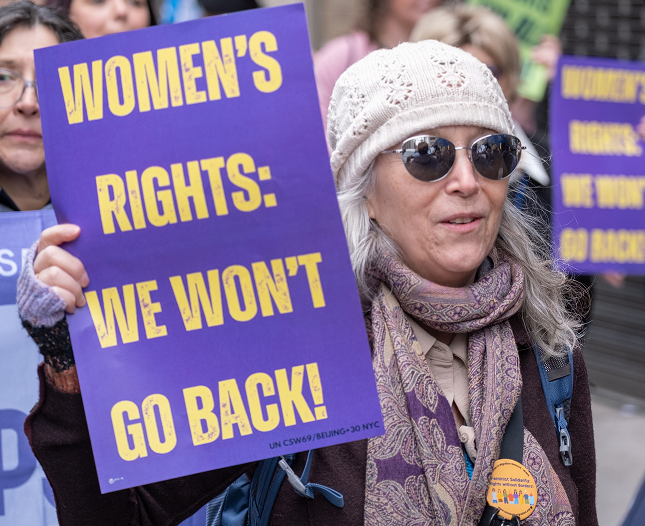
Challenging Patriarchy and Fundamentalism Through Gender Justice

Elaine Neuenfeldt, Gender Justice Programme Manager at ACT Alliance, shares how faith-based strategies, cross-sector alliances, and transformative theologies are countering backlash and advancing equality worldwide.

01
Institutionalising Gender Justice Across the Alliance
01

Institutionalising Gender Justice Across the Alliance

  • Revision of the Gender Justice Policy and alignment with the Quality and Accountability Framework
  • Establishment of shared standards and compliance expectations across members
  • Improved internal accountability, learning, and investment in gender-transformative programming
02
Strengthening Global Advocacy and Faith-Based Voice
02

Strengthening Global Advocacy and Faith-Based Voice

  • Coordinated engagement at the Commission on the Status of Women, Commission on Population and Development, and Human Rights Council
  • Mobilisation of over 25 members in joint advocacy, side events, and global convenings
  • Co-convening of a high-level roundtable on joint leadership with UN agencies, feminist organisations, and faith-based partners
  • Co-organisation of the International Conference on Family Planning panel in Bogotá with partners including UNFPA, the German Federal Foreign Office, and regional networks
  • Amplified faith-rooted advocacy challenging regressive narratives on SRHR and gender equality
03
Advancing Regional Leadership and Locally Led Approaches
03

Advancing Regional Leadership and Locally Led Approaches

  • Family Law Workshop in Amman convened 38 participants from 12 countries to advance gender-equal legal reform
  • Participation of 13 members in the IX Latin American Congress on Gender and Religion, contributing to regional theological engagement
  • Webinars and dialogues in Africa addressed technology-facilitated gender-based violence and informed 16 Days of Activism advocacy
  • Continued implementation of the Women in Leadership Academy in Asia-Pacific, including dedicated learning sessions with programme graduates
  • Expanded regionally led initiatives across Africa, Asia-Pacific, Latin America and the Caribbean, and the Middle East
04
Deepening Theological Engagement and Norm Change
04

Deepening Theological Engagement and Norm Change

  • Establishment of the Global Theological Reference Group to guide faith-informed approaches to the programmatic work in the Alliance (humanitarian, gender and climate)
  • Use of theological resources, including “Will It Be of God?”, to support dialogue on faith and human rights
  • Advancement of decolonised and interfaith theological frameworks in collaboration with feminist movements
  • Integration of theological reflection into advocacy on SRHR, GBV, and gender equality
05
Strengthening Capacity on Emerging Gender Justice Issues
05

Strengthening Capacity on Emerging Gender Justice Issues

  • Increased focus on technology-facilitated gender-based violence across regional programming
  • Delivery of targeted webinars and learning dialogues to build member capacity on digital GBV
  • Integration of gender considerations into climate and resilience work, including GBV risk mitigation
  • Enhanced capacity to respond to evolving risks in digital and civic spaces
06
Leveraging Partnerships and Collective Action
06

Leveraging Partnerships and Collective Action

  • Expanded collaboration with UN agencies, including UNFPA, and engagement with government actors
  • Deepened partnerships with feminist organisations and regional networks
  • Coordinated advocacy and programming across faith-based and rights-based actors
  • Increased alignment to counter anti-rights movements and shrinking civic space
07
Generating Evidence and Knowledge for Advocacy and Practice
07

Generating Evidence and Knowledge for Advocacy and Practice

  • Publication of global reports marking 30 years of the Beijing Platform for Action and ICPD Programme of Action
  • Documentation of faith-based contributions to norm change and gender justice advocacy
  • Development of research-based resources to support policymakers and practitioners
  • Increased use of evidence to elevate progressive faith voices in global spaces
08
Strengthening Cross-Regional Learning and Collaboration
08

Strengthening Cross-Regional Learning and Collaboration

  • Communities of Practice facilitated exchange on GBV, SRHR, climate and gender justice, and transformative masculinities
  • Cross-regional knowledge sharing informed programme design and advocacy approaches
  • Peer learning supported adaptation of context-specific solutions across regions

Integration of shared learning into regional and global programming

ACT Alliance maintained a visible presence in global policy and advocacy spaces, contributing a progressive faith voice in increasingly contested environments.

  • A key milestone was the revision of the ACT Alliance Gender Justice Policy, aligned with the updated Quality and Accountability Framework. This established clearer shared standards across the Alliance and a stronger basis for accountability, learning, and future investment in gender-transformative action. ACT also expanded its engagement in global policy spaces, advanced regional leadership, and deepened collaboration across its network.
  • Coordinated engagement across major global platforms, including the Commission on the Status of Women, the Commission on Population and Development, and the Human Rights Council
  • Mobilised over 25 members through joint delegations, high-level side events, and collective advocacy efforts, increasing visibility and influence
  • Co-convened a high-level roundtable on “Joint Leadership to Push Forward for Gender Justice”, bringing together United Nations agencies, feminist organisations, and faith-based partners to align priorities and strengthen collaboration
  • Deepened partnerships with UN agencies, governments, and feminist movements, positioning ACT as a bridge between faith-based and rights-based actors

ACT expanded its global advocacy through targeted convenings and strategic partnerships. At the International Conference on Family Planning in Bogotá, the Alliance partnered with the Berlin Institute for Population and Development, UNFPA, the German Federal Foreign Office, and the Network of Catholics for the Right to Decide in Latin America and the Caribbean.

  • Co-organised the panel “Reclaiming Reproductive Rights and Transforming Taboos and Social Norms Amid Growing Resistance”
  • Brought together specialists, activists, and decision-makers to address emerging challenges in sexual and reproductive rights
  • Advanced dialogue on countering regressive narratives and promoting gender equality in highly polarised policy environments

Africa


Addressing Technology-Facilitated Gender-Based Violence: In Africa, capacity development responded to emerging forms of gender-based violence in digital spaces and their growing impact.

  • Delivered webinars and learning dialogues to equip members to prevent and respond to technology-facilitated GBV
  • Linked learning processes to advocacy efforts, including contributions to the 16 Days of Activism campaign
  • Facilitated regional dialogues on women’s health and sexual and reproductive health and rights through faith-based engagement, increasing member awareness.

Asia-Pacific


Women in Leadership and Transformative Capacity Development: The region continued to advance leadership development through sustained, locally grounded approaches.n all their diversity to lead and thrive.

  • Continued implementation of the Women in Leadership Academy as a core capacity initiative
  • Convened a dedicated learning session with programme graduates, fostering peer exchange, mentoring, and reflection
  • Advanced long-term leadership pathways for women within ACT member organisations
  • Reinforced the role of structured accompaniment in enabling sustained leadership

Middle East and North Africa (MENA)


Family Law Reform and Gender Equality: Regional efforts focused on advancing gender-equal legal frameworks and collaboration across contexts, particularly in complex legal environments.

  • 38 participants from 12 countries engaged in dialogue on gender-equal family law reform
  • Advanced collaboration to promote more inclusive and equitable legal frameworks, with a focus on minority Christian contexts
  • Facilitated peer exchange between legal, faith, and advocacy actors working on reform processes
  • Promoted locally led approaches to advocacy, ensuring contextual relevance and ownership
  • Regional Gender justice workshop attended by 20 participants from 6 countries, developing gender justice guidance and terminology booklet.

Latin America and the Caribbean (LAC)


Faith and Feminism Dialogue and Theological Engagement: Work in the region focused on deepening theological reflection and collaboration between faith-based and feminist actors.

  • 13 participants engaged in the IX Latin American Congress on Gender and Religion at EST Faculties in Brazil
  • Consolidated the Dialogue Forum between Faith and Feminism as a key regional platform for exchange and strategy
  • Advanced collective analysis of the theological resource Will It Be of God? Gender Justice Argumentario, developed by the LAC Gender Community of Practice and the Global Gender Justice Programme. Will it be of God- Gender Justice Argumentario – ACT Alliance
  • Expanded capacity to engage in faith-based narratives that support human rights and gender equality

In 2026, ACT Alliance will scale the institutionalisation of gender justice, strengthen theological engagement, and deepen partnerships to advance rights-based and faith-rooted approaches across global, regional, and national levels. This will include:

Rolling Out the Gender Justice Policy

  • Global and regional implementation of the revised Gender Justice Policy through workshops, webinars, and policy dialogues
  • Member-wide mapping of policy uptake and contextualisation across regions
  • Strengthening alignment with the Quality and Accountability Framework

Expanding Theological Engagement and Learning

  • Scaling the work of the Global Theological Reference Group
  • Delivery of global and regional webinars and “conversatorios” on SRHR, GBV, transformative masculinities, and countering fundamentalisms
  • Strengthening interfaith and decolonised theological approaches to gender justice

Advancing Integrated and Gender-Responsive Programming

  • Strengthening the integration of gender justice across climate and resilience programming
  • Regional leadership consultation on climate and gender justice in Asia-Pacific
  • Increased focus on GBV risk mitigation across thematic areas

Deepening Partnerships and Collective Advocacy

  • Expanding collaboration with faith-based and rights-based actors, including LGBTQIA+ and SRHR movements
  • Continued coordinated engagement in global advocacy spaces including CSW, CPD, and the Human Rights Council
  • Strengthening joint advocacy, delegations, and side events across regions

Strengthening Learning, Evidence, and Accountability

  • Implementation of enhanced MEAL approaches including Outcome Harvesting and member surveys
  • Documentation of best practices and lessons learned across regions
  • Strengthening knowledge generation to inform programming and advocacy