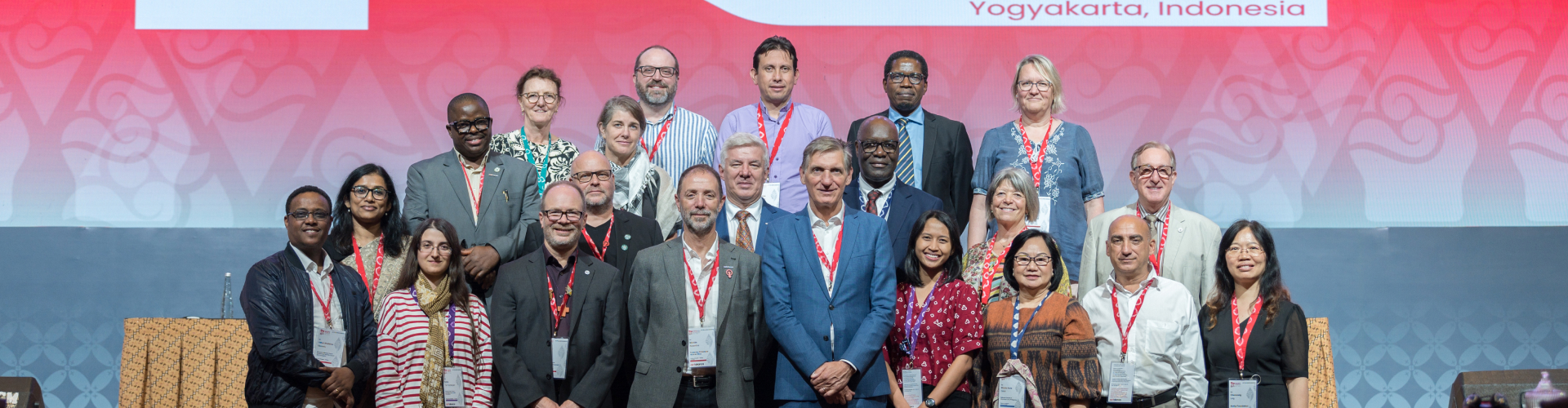
Governing Board 2024
In November 2024, ACT Alliance welcomed a newly elected Governing Board reflecting the diversity of its global membership. Comprising experienced leaders and emerging voices from across regions and faith traditions, the new Board carries forward ACT’s values of dignity, inclusion, and collective action. The full elected Governing Board consists of:
Yilikal Shiferaw
Africa
EOC-DICAC (Ethiopia)
Evans Onyemara
Africa
CCN (Nigeria)
Melton Luhanga
Africa
CARD (Malawi)
Minnie Anne Calub
Asia
NCCP (Philippines)
Ling Chunxiang
Asia
Amity Foundation (China)
Juliate Malakar
Asia
Rommie Nauta
Western Europe
Kerk in Actie (NL)
Martin Kessler
Western Europe
DKH (Germany)
Tomi Järvinen
Western Europe
FCA (Finland)
Edna Ter-Vardanyan
Eastern Europe
ART Armenia
Casey Harden
Global
World YWCA
Joel Dopico
Global
CIC (Cuba)
Nicolás Rosenthal
Global
FP Hora de Obrar (Argentina)
Atahualpa Hernández Miranda
LAC
ILECO (Colombia)
Samer Lahham
MENA
MECC
Laurie Kraus
North America
PDA (USA)
Guy Smagghe
North America
PWS\&D (Canada)
Peter Keegan
Pacific
UnitingWorld (Australia)
Brigita Ra Sekar Laras
South Asia
YAKKUM (Indonesia)
Jean Wambui Karari
Afrida
ADS (Kenya)
Kenneth Mtata
WCC permanent
WCC
Maria Immonen
LWF permanent
LWF
Tariro Washaya
Africa
MeDRA (Zimbabwe)
Kishore Kumar Nag
Asia
LWSIT (India)
Patrick Watt
Europe
Christian Aid (UK)
Horacio Mesones
Latin America & Caribbean
CREAS (Argentina)
Jo Knight
Pacific
Anglican Overseas Aid (Australia)
One of the outgoing Board’s key priorities was financial sustainability. This included approving steps toward a revised Funding Model to promote fairness, transparency, and predictable contributions across the membership. The Board also reviewed the 2024 audited financial accounts, assessed 2025 financial updates, and explored ways to strengthen ACT’s core financial stability.
To support stronger member engagement and accountability, the Board ratified a revised Membership Model, clarifying roles, responsibilities, and expectations across the Alliance.
During the mid-term review of the Global Strategy, the Board found implementation largely on track, with minor shifts to strengthen internal cohesion, integrate decolonisation efforts, and enhance youth participation. These refinements were endorsed, extending the Strategy’s relevance through 2027.
The Board also held strategic discussions on governance and statutory reforms, and assessed regional and global risks, including political polarisation and shifting humanitarian contexts, to better prepare the Alliance for emerging challenges.
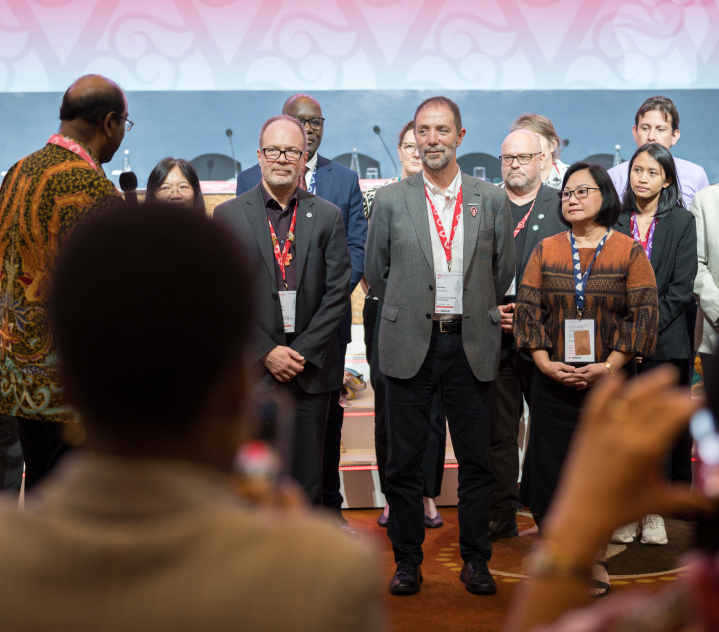
Strengthening Member Engagement
To support stronger member engagement and accountability, the Board ratified a revised Membership Model, clarifying roles, responsibilities, and expectations across the Alliance. During the mid-term review of the Global Strategy, the Board noted that implementation was largely on track, with minor shifts to strengthen internal cohesion, integrate decolonisation efforts, and enhance youth participation. These refinements were endorsed, extending the Strategy’s relevance through 2027.