Advocacy

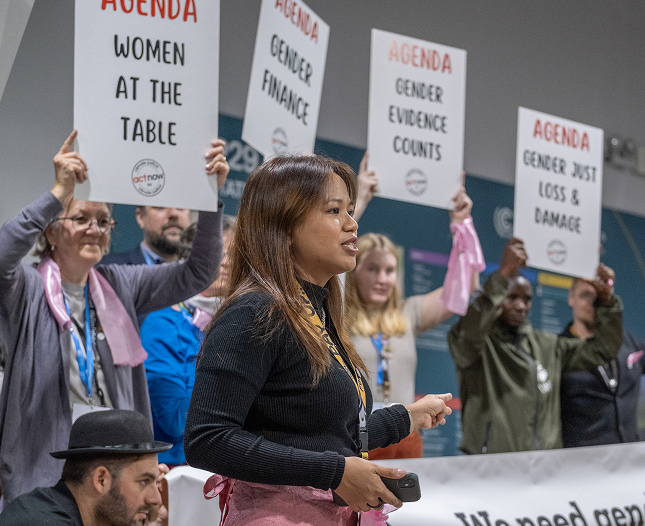
In 2025, ACT Alliance’s advocacy work responded to a rapidly changing context marked by shrinking civic space, rising fundamentalisms, weakening multilateralism, and escalating conflict. Members increasingly witness religion being used to justify exclusion, threaten democracy, and undermine human rights, in their regions and globally.

In response, ACT strengthened its role as a collective, faith and rights-based alliance, mobilising members to advance locally led solutions grounded in justice, dignity, and human rights, with fundamentalisms and shrinking civic space treated as cross-cutting challenges affecting advocacy for climate justice, gender equality, migration, and peacebuilding. ACT also deepened engagement on structural inequalities, particularly economic justice, financing for development, and the UN Tax Convention.

2025 also marked a strategic shift towards more focused, high-impact advocacy, prioritising depth over breadth, strengthening collaboration across the Alliance, and investing in multistakeholder partnerships to create greater coherence and alignment in global advocacy.

The ACT Advocacy Academy remained a flagship initiative for building sustained advocacy capacity, equipping participants with practical skills and concrete plans to engage in policy processes, challenge injustice, and amplify faith-based community voices.

91 participants participated in the ACT Advocacy Academy from 56 ACT member and partner organisations across 32 countries.

Fundamentalism and ACT’s UN Tax Convention work

01
Confronting Fundamentalisms Across Advocacy Spaces
01

Confronting Fundamentalisms Across Advocacy Spaces: ACT Alliance deepened its work addressing the rise of fundamentalisms, particularly the instrumentalisation of religion in political and social spaces. This included strengthening collaboration between members, such as ACT Fesur, and external partners, including UN OHCHR, to better analyse, respond to, and counter narratives that undermine human rights, particularly in gender justice and civic space.

02
Advancing Economic Justice
02

Advancing Economic Justice: Building on its commitment to addressing structural and intersecting inequalities, ACT Alliance continued to play an active role in global conversations on economic justice, including tax and debt justice. The Alliance coordinated joint advocacy messages and produced a Financing for Development (FFD4) Briefing Paper to align members and partners around key economic justice priorities. ACT also joined the Jubilee Turn Debt into Hope campaign, with active engagement from some ACT Forums. Through its Community of Practice on the UN Tax Convention, members contributed to shaping collective positions on reforming global financial systems.

03
Enhancing Interconnected Advocacy - National - Regional - Global
03

Enhancing Interconnected Advocacy – National – Regional – Global: ACT Alliance continued to bridge grassroots realities with global policy processes, with members engaged in advocacy at national, regional, and international levels, ensuring lived experience and programmatic expertise inform global decision-making.

04
Strengthening Collaboration Across the Advocacy Ecosystem
04

Strengthening Collaboration Across the Advocacy Ecosystem: Recognising that no single actor can address today’s complex challenges alone, ACT worked more intentionally to strengthen collaboration across ecumenical agencies and civil society partners, coordinating advocacy to ensure complementarity, reduce duplication, and maximise collective impact.

05
Amplifying Faith-Based Voices in Global Policy Spaces
05

Amplifying Faith-Based Voices in Global Policy Spaces: ACT Alliance maintained its presence in global advocacy spaces, contributing faith and rights-based perspectives to key policy discussions. Through engagement with UN agencies and multilateral platforms, the Alliance reinforced the importance of values-driven advocacy in shaping inclusive and just policies.

In 2026 ACT Alliance’s Advocacy work will focus on:

01

Deepening efforts to counter fundamentalisms and defend civic space

02

Strengthening forum-centred and locally led advocacy

03

Enhancing strategic, interconnected advocacy across local, regional, and global levels

04

Expanding collaborative approaches within the advocacy ecosystem to maximise impact