Migration and Displacement

In 2025, migration and displacement intensified globally, driven by climate change, conflict, inequality, and socioeconomic pressures, with human mobility increasing across regions through both forced displacement and movement linked to survival and opportunity. Political discourse became increasingly securitised, marked by tighter border controls, externalisation policies, and the criminalisation of migrants and those who support them.

Civil society actors working on migration faced growing restrictions on civic space, legal barriers in some contexts, heightened scrutiny, and reduced funding across humanitarian, multilateral, and civil society systems.

Despite these pressures, ACT Alliance and its members sustained rights-based advocacy and coordination across regions, adapting approaches to remain relevant and effective in restrictive environments. A key development was the reactivation and consolidation of the Migration and Displacement programme architecture following global member consultations, which reaffirmed four priorities:

  • Protection of rights
  • Shifting migration narratives
  • Policy influence at multiple levels
  • Faith-based solidarity

Defending Migrants’ Rights in a Changing Climate

Karol Arámbula, Migration and Displacement Programme Manager at ACT Alliance, highlights the rising displacement crisis and how ACT is advocating for migrant rights while supporting communities on the move through policy engagement and humanitarian response.

01
Strengthening Global Coordination and Programme Architecture
01

Strengthening Global Coordination and Programme Architecture

  • Reference Group on Migration and Displacement revitalised in 2025, with expanded membership including youth participation
  • Global consultation process completed, bringing together members across regions
  • Programme-wide mapping exercise undertaken to identify where members are working and their priority areas
  • 2025- 2026 advocacy priorities aligned across the network, strengthening coordinated global action
  • Programme architecture formally reactivated after a period of absence in global facilitation, consolidating ACT’s migration work structure
02
Advancing Regional Collaboration and Community Platforms
02

Advancing Regional Collaboration and Community Platforms

  • Established a Regional Community of Practice on Human Mobility in Latin America and the Caribbean, engaging 13+ ACT members to strengthen joint advocacy and programming coordination
  • “Church in Migration” initiative reactivated in the Middle East and North Africa, strengthening faith-based collaboration on migration and displacement
  • Regional consultations launched to strengthen coordination and alignment of member priorities across forums
03
Strengthening Rights-Based Advocacy and Policy Engagement
03

Strengthening Rights-Based Advocacy and Policy Engagement

  • Regional reviews of the Global Compact for Safe, Orderly and Regular Migration (GCM) in 2025
  • Member-led engagement supported inclusion of migrant rights in national policy discussions, including electoral processes such as in Honduras
  • Advocacy positioned migration as a rights-based and dignity-centred agenda in increasingly restrictive policy environments
04
Amplifying Migrant Voices and Evidence-Based Advocacy
04

Amplifying Migrant Voices and Evidence-Based Advocacy

  • Member-led production of migrant storytelling materials, including documented lived experiences of climate-induced displacement
  • Community narratives integrated into regional and global advocacy processes, including policy engagement materials
  • Evidence collection strengthened through consultations and documentation processes supporting advocacy at multiple levels
05
Strengthening Cross-Programme Integration and Collaboration
05

Strengthening Cross-Programme Integration and Collaboration

  • Migration work integrated with climate justice, gender justice, peace and security, and humanitarian programming
  • Inter-programmatic collaboration strengthened through joint advocacy planning and consultations
  • Capacity strengthening identified as a core priority area across members to improve advocacy and technical expertise
  • Forum-driven collaboration model reinforced, improving joint action and coordination across ACT members

In 2025, the Reference Group on Migration and Displacement was revitalised, with expanded membership including youth participation. A global consultation process, launched and completed in 2025, brought together members from various regions to:

  • Map where members are working and which priorities they are focusing on
  • Align shared advocacy agendas for 2025 – 2026
  • Strengthen coordination on rights-based migration efforts

ACT Alliance strengthened coordinated, evidence-based advocacy on migration and displacement through ongoing engagement in global policy processes, including the Global Compact for Safe, Orderly and Regular Migration regional review processes, reinforcing its position as a framework for policy dialogue grounded in human rights and safe migration pathways.

Members reinforced the connection between global migration frameworks and national-level advocacy, supporting more consistent engagement with governments on migration governance and rights-based approaches to human mobility.

The programme also promoted cross-thematic integration, addressing migration alongside climate justice, gender justice, humanitarian response, and peace and human security within shared advocacy and programming strategies.

This process informed the relaunch of the programme architecture and global priority setting, including capacity strengthening and inter-programmatic alignment.

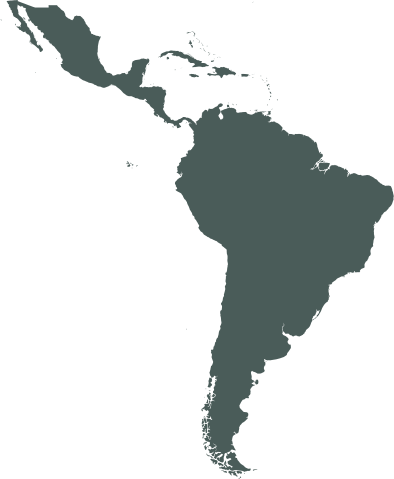
Latin America and Columbia (LAC)


In Latin America and the Caribbean, ACT members strengthened coordinated advocacy and regional collaboration on human mobility, with a focus on rights-based approaches, climate-induced displacement, and amplifying migrant voices in policy spaces.

  • Established the first regional Community of Practice on Human Mobility, bringing together over 13 members to strengthen joint advocacy, programming, and response coordination.
  • Strengthened regional advocacy alignment through collective engagement on migration governance, including national-level policy and electoral processes such as in Honduras.
  • Advanced evidence-based and narrative advocacy by supporting member-led documentation of migrant and displaced persons’ lived experiences, including the development of storytelling materials used in regional and global policy engagement.
  • Enhanced cross-regional learning and coordination through consultations and joint planning processes, strengthening a forum-driven model for migration work across ACT members.

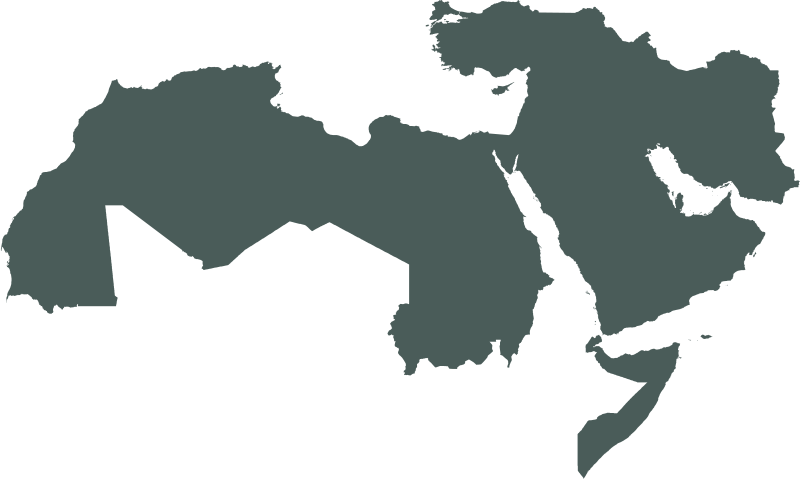
Middle East and North Africa (MENA)

In the Middle East and North Africa, ACT members strengthened faith-based engagement on migration and displacement, deepening theological reflection and regional collaboration in contexts of prolonged crisis and increasing pressure on civic space and migration discourse.

  • Reactivated regional collaboration through the “Church in Migration” initiative, bringing together ACT members to engage jointly on migration-related challenges from a faith perspective.

Advanced theological dialogue processes exploring migration, displacement, and faith responses, supporting members to engage more consistently with rights-based and dignity-centred narratives in highly sensitive contexts.

In 2026, the Migration and Displacement Programme will focus on:

  • Continuing member consultations and surveys to strengthen coordination, shared priorities, and collective action across regions
  • Strengthening member capacity on rights-based advocacy for people on the move, including in contexts of shrinking civic space and operational risk
  • Engaging in global policy processes, including the International Migration Review Forum (IMRF), and continued advocacy within the Global Compact for Migration framework
  • Strengthening inter-programme collaboration with Climate Justice, Gender Justice, Peace and Human Security, and Humanitarian Response programmes
  • Enhancing storytelling, evidence collection, and communication strategies to counter harmful narratives and amplify migrant and displaced voices
  • Supporting members to adapt and sustain programming amid ongoing funding constraints, civic space restrictions, and increasing operational pressures