Peace and human security can only be achieved through collaborative efforts, especially ecumenical and interfaith approaches.

Elizabeth Kiisigha Zimba, ACT's Peace and Human Security focal point, shares how members are fostering community trust, diffusing conflicts, and promoting sustainable peace while advancing the Peace and Human Security programme’s priorities for 2025.




Through engagement with the World Council of Churches, the All Africa Conference of Churches, and national and regional church networks, ACT strengthened dialogue, aligned peacebuilding efforts, and accompanied actors working on the frontlines of conflict, an approach central to ACT's contribution to peace and human security in an increasingly fragmented and volatile world.
In response to renewed tensions and political instability in South Sudan, ACT engaged through the Ecumenical Network on South Sudan (ENSS) to convene a consultative meeting with church leaders and key stakeholders, examining the drivers of conflict, including political rivalries and fragilities within the peace process, and the role of church-led shuttle diplomacy in mitigating tensions.
The consultations produced a shared commitment to organise a high-level ecumenical solidarity visit to South Sudan, demonstrating unified support for peace and reinforcing the role of faith actors in mediation and reconciliation. ACT continued to accompany the South Sudan Council of Churches (SSCC), strengthening ecumenical collaboration as a cornerstone of sustainable peacebuilding in the country.

In response to the escalating conflict in Sudan, the programme prioritised coordinated ecumenical engagement. In partnership with the World Council of Churches (WCC), the All Africa Conference of Churches (AACC), the Fellowship of Christian Councils and Churches in the Great Lakes and Horn of Africa (FECCLAHA), and the Sudan Council of Churches (SCC), ACT convened consultations towards forming an Ecumenical Network on Sudan, aligning actors around a unified response to the ongoing violence, mass displacement, and humanitarian crisis affecting civilians across the country and region.
Further consultations with church leadership, including the Archbishop of the Episcopal Church in Sudan and representatives of the Sudan Council of Churches, assessed the evolving security situation and explored pathways for coordinated peace initiatives, including the potential role of emerging bodies such as the New Sudan Council of Churches (NSCC) in the Nuba Mountains. These efforts reinforced ACT’s commitment to accompanying local faith actors and strengthening ecumenical responses in highly fragile contexts.

Amid continued conflict and instability in eastern DRC, ACT Alliance convened strategic discussions with ecumenical partners including WCC, AACC, and FECCLAHA to assess the situation and identify pathways for coordinated response, focused on the escalating violence, loss of life, and large-scale displacement affecting communities within DRC and across neighbouring countries.
A key outcome was AACC’s agreement to lead the convening of senior church leaders from DRC in a neutral setting to foster dialogue and strengthen the Church’s role in peacebuilding, reflecting ACT’s broader approach of leveraging ecumenical leadership and partnerships to create safe spaces for dialogue, reflection, and collective action in conflict-affected contexts.
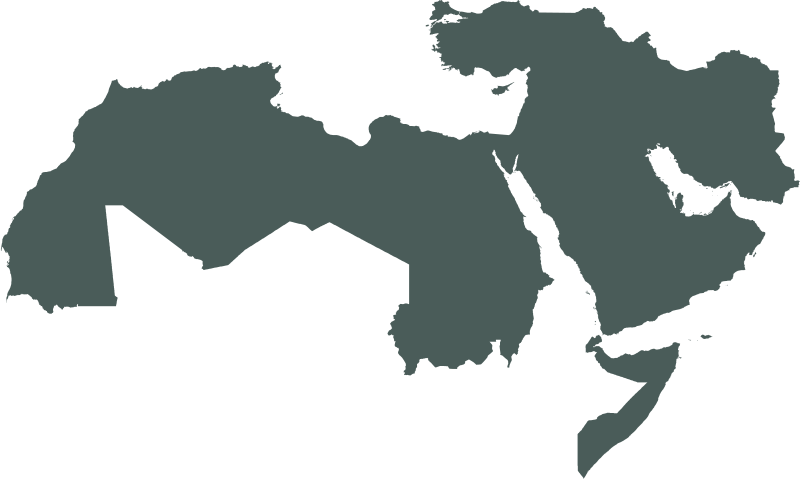
In 2025, the global peace and security landscape was marked by escalating conflict across regions where ACT Alliance is actively engaged, including Sudan, South Sudan, the Democratic Republic of Congo (DRC), Gaza, and Cameroon. Fragile peace agreements, political instability, geopolitical tensions, and competition over natural resources deepened humanitarian needs and reinforced the need for coordinated, locally led peacebuilding.
In response, ACT Alliance strengthened its role as a convener of ecumenical collaboration, bringing together churches, national councils of churches, regional ecumenical bodies, and global partners to coordinate peacebuilding, humanitarian advocacy, and mediation. Working with the World Council of Churches (WCC), the All Africa Conference of Churches (AACC), and the Fellowship of Christian Councils and Churches in the Great Lakes and Horn of Africa (FECCLAHA), the programme expanded collaborative peace platforms and strengthened faith-based engagement in some of the world’s most fragile contexts.
The programme also strengthened the Africa Community of Practice on Peace and Human Security and operationalised the Peace and Human Security Reference Group, creating stronger mechanisms for peer learning, strategic coordination, and integrated approaches linking humanitarian action, development, and peacebuilding. Through these platforms, ACT members advanced advocacy on locally led peace processes, the Humanitarian-Development-Peace Nexus, and the role of women and young people in building sustainable peace.
For 2026, The Peace and Human Security programme will prioritise: